 RHOTHETA Elektronik
RT-600
Multi-Band Direction Finder System for Airborne SAR
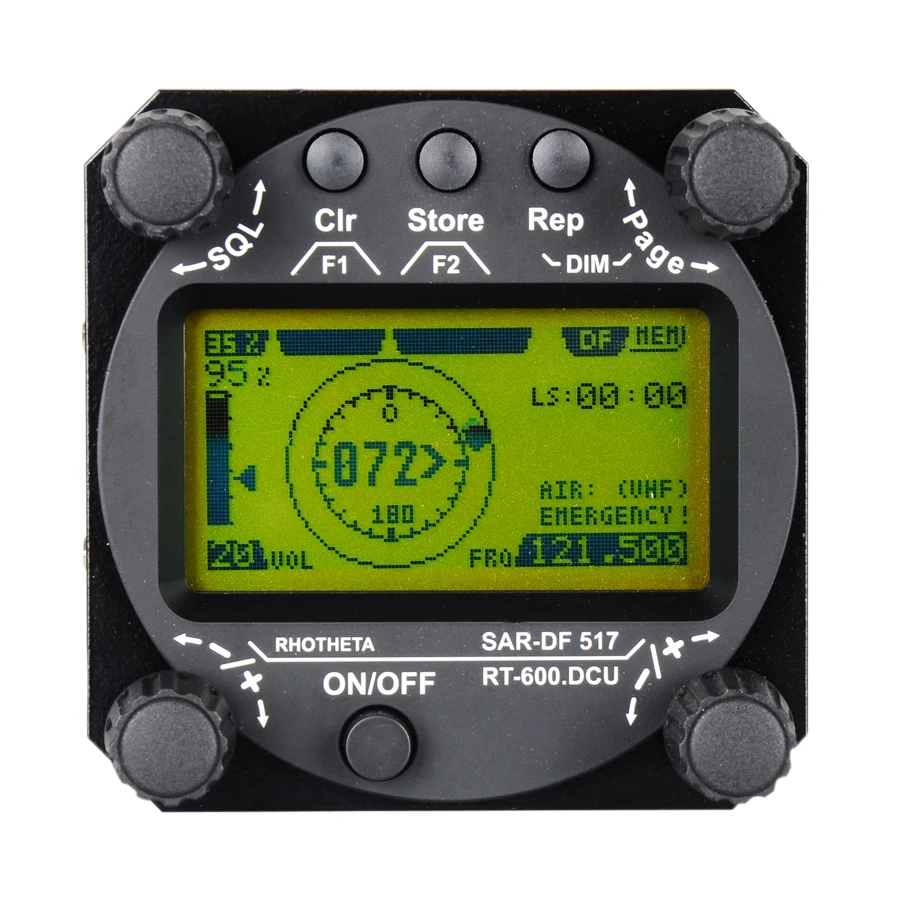
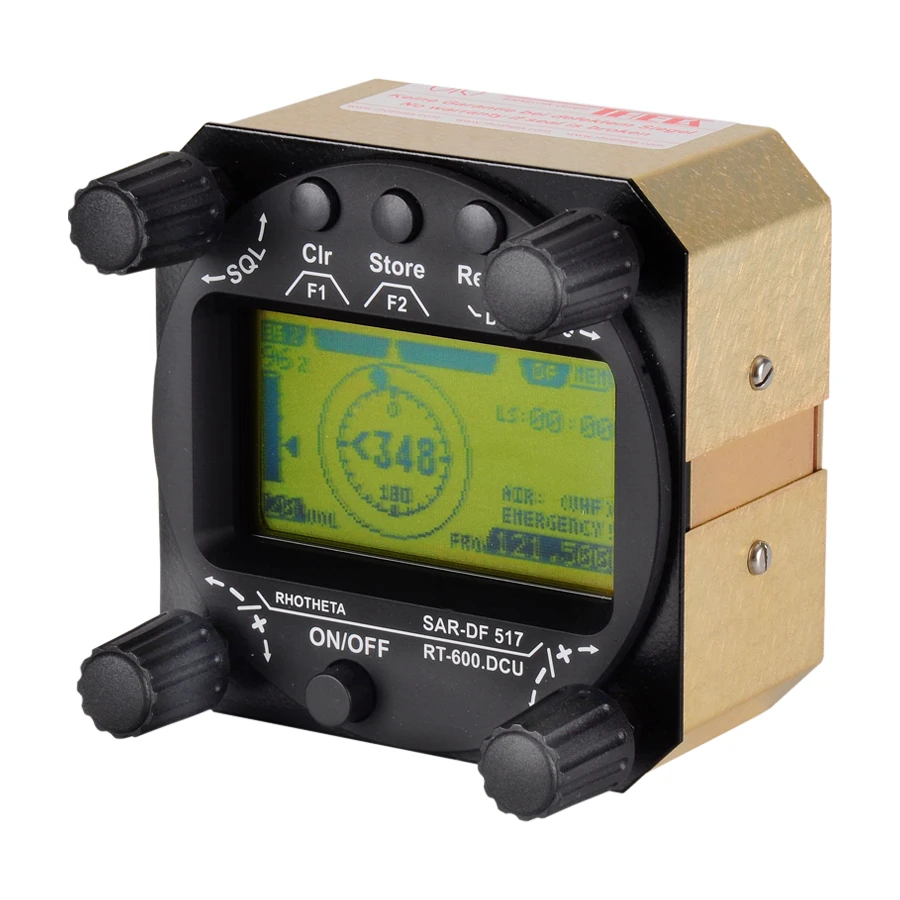
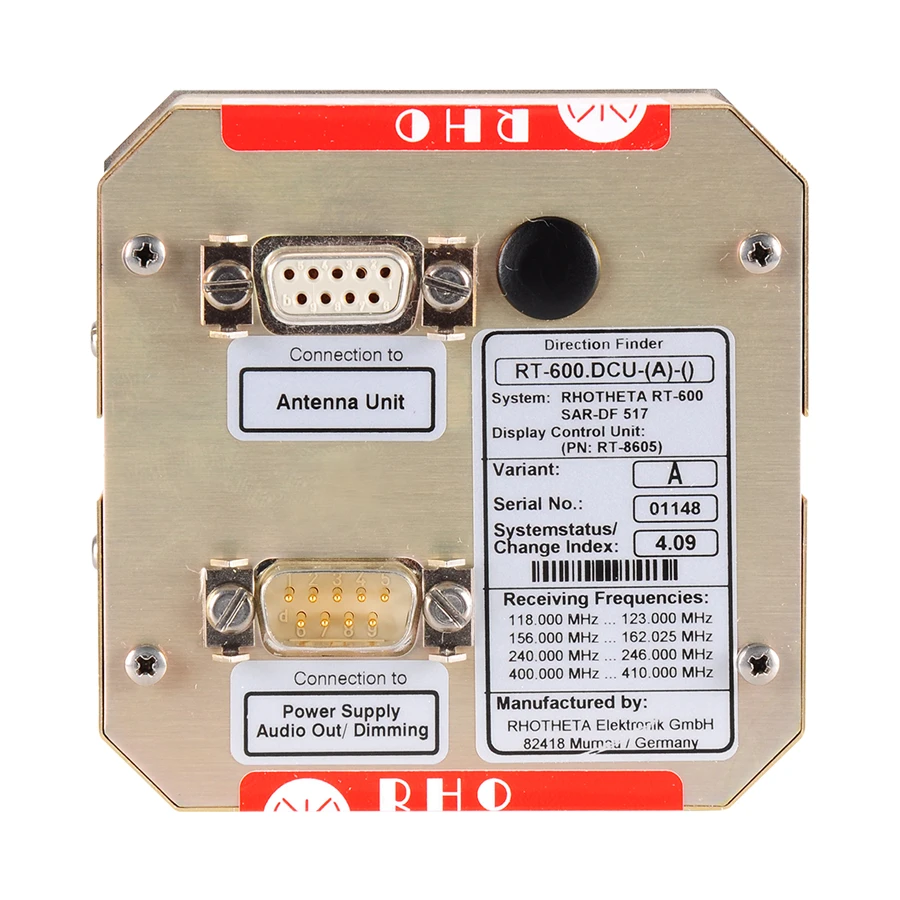
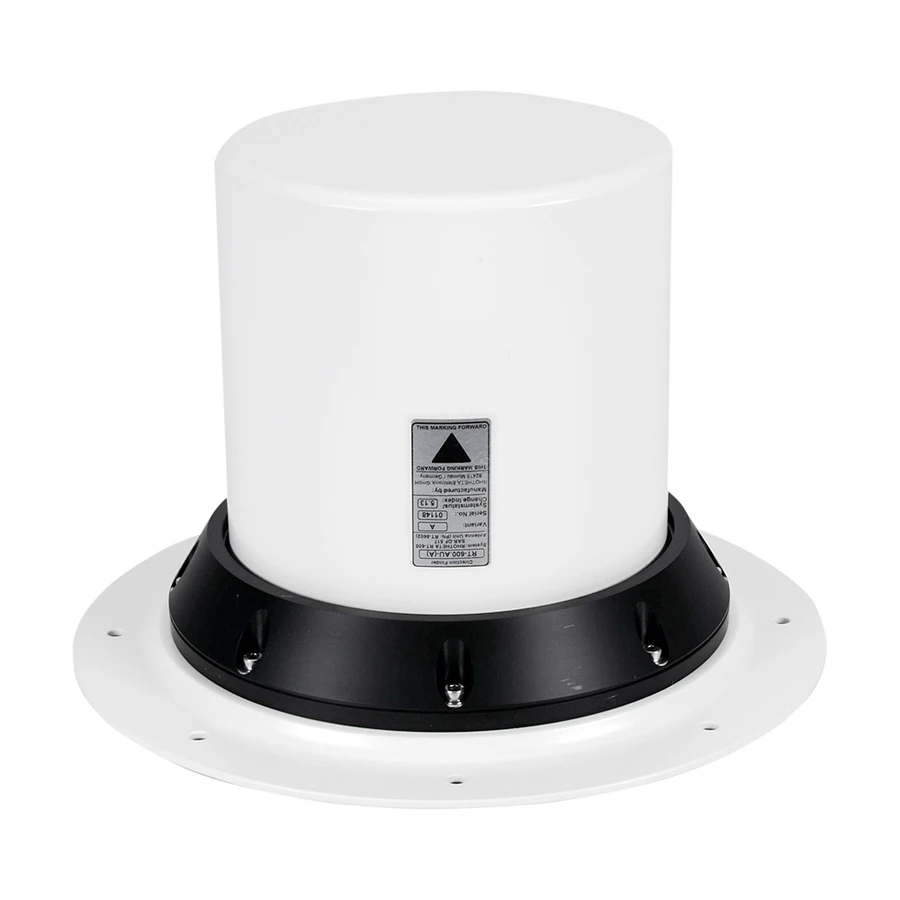
The RT-600 (SAR-DF 517) is a SAR direction finder system for airborne SAR that operates on all frequency bands used for rescue missions, including emergency frequencies 121.500 MHz, 243.000 MHz and 406.028 MHz COSPAS/SARSAT as well as channel 16 of the marine band. Emergency beacons that operate on the COSPAS/SARSAT frequency 406.028 MHz can be identified and localized. No additional equipment is required in the aircraft since the electronic direction finding components are integrated into the antenna. The display and control unit consists of a 80-mm round instrument, and the graphic LCD display permits convenient viewing of localization and COSPAS/SARSAT information.
| Method of bearing: | Doppler principle (3 kHz rotational frequency, right / left rotation) |
|---|---|
| Bearing accuracy: | ±5° RMS1 |
| Internal resolution: | 1° |
| Bearing Sensitivity: | VHF Air/Emergency: ±5° bearing fluctuation ≤ 6 μV/m / 4 μV/m (typical) VHF Marine Band: ±5° bearing fluctuation ≤ 5 μV/m / 2.5 μV/m (typical) LoJack Decoding: ±5° bearing fluctuation ≤ 5 μV/m / 2 μV/m (typical) |
| Frequency stability: | ±2.0 ppm (b,.f/f = ±2 X 10·6) |
| Reception frequencies, SAR version (standard): | VHF Emergency Band: 118.000 to 124.000 MHz (8.33 kHz steps, AM) VHF Marine Band: 154.000 to 163.000 MHz (5.00 kHz steps, FM) UHF Emergency Band: 240.000 to 246.000 MHz (25.00 kHz steps, AM) UHF FM-Band: 406.100 to 410.000 MHz (5.00 kHz steps, FM) COSPAS/SARSAT: 400.000 to 406.092 MHz lncl. 406.022 to 406.076 MHz (Channel A … S) Additional Frequency Options: F1 VHF Air Band: 118.000 to 136.992 MHz (8.33 kHz steps, AM) F2 extended VHF Marine Band: 137.000 to 224.995 MHz (5.00 kHz steps, FM) F3 extended UHF Air Band: 225.000 to 399.975 MHz (25.00 kHz steps, AM) F4 additional UHF FM Band: 406.100 to 470.000 MHz (5.00 kHz steps, FM) |
| Reception frequencies, Law Enforcement version: | VHF Emergency Band: 118.000 to 124.000 MHz (8.33 kHz steps, AM) VHF Marine Band: 154.000 to 163.000 MHz (5.00 kHz steps, FM) LoJack: 164.000 to 174.000 MHz (12.5 kHz steps) ETS: 216.000 to 220.000 MHz (10/12.5 kHz steps, FM) COSPAS/SARSAT: 400.000 to 406.092 MHz lncl. 406.022 to 406.076 MHz (Channel A … S) Additional Frequency Options: Fl VHF Air Band: 118.000 to 136.992 MHz (8.33 kHz steps, AM) F2 extended VHF Marine Band: 137.000 to 163.000 MHz (5.00 kHz steps, FM) |
| COSPAS/SARSAT freq.: | Channels A to S (406.022 to 406.076 MHz) |
| COSPAS/SARSAT Fast scan mode: | Full automatic detection of any active COSPAS/SARSAT channel A to S within 400 ms |
| COSPAS/SARSAT decoding: | Reception and decoding of COSPAS/SARSAT data signal (112 or 144 bit, 400 baud, biphase L encoded, phase modulation, with Bose-Chaudhuri-Hocquenghem errorcorrecting code, specified according to COSPAS/SARSAT C/S T.001 October 1999) |
| LoJack decoding: | Selectable LoJack ID display and selective active filtering |
| Special scanning modes: | Complete maritime ship band scanning within 3 s |
| Bearable modulation: | A3E, F3E, A3X (ELT modulation), Fl D, G2D, COSPAS/SARSAT Bearing largely independent of modulation |
| Polarization: | Vertical |
| Polarization error: | ≤ 5° at 60° field vector rotation |
| Cone of silence: | 30° to the vertical |
| Response time2: | ≤ 50 ms (with sufficient reception field strength) |
| LC-graphic display: | 128 x 64 pixels, supertwist / transflective, extended range of temperature, dark-blue display on yellow-green background, background light. |
| NVG cockpit design: | Freely adjustable (exponential) dimming of brightness |
| Operating voltage: | Fully compatible NVIS Green B display Control Unit optional |
| Current consumption: | LCD-background light “OFF“ : 500 mA at 12 V DC, 250 mA at 24 V DC LCD-background light at 100 %: 750 mA at 12 V DC, 350 mA at 24 V DC Option NVG, LCD-background light at 100 %: 900 mA at 12 V DC, 400 mA at 24 V DC RT-600 Light (AU only): 200 mA at 12 V DC, 100 mA at 24 V DC |
| Audio out: | External speaker 2 W (4 Ω) Maximum output voltage 8 V pp at maximum volume |
| Interface: | Serial interface RS-232 (9600 baud, 8 data bits, 1 stop bit, no parity) Analog dimming input voltage for legends Night/NVG input dimming line for LCD-background light |
| Options: | - NVIS Display - ARING 429 Adapter - Ramp Tester - Antenna light weight version for UAV (RT-600 Light) |
| Display Control Unit (DCU): | Weight: 250 g Operating temperature: -20°C to +60°C Storage temperature: -30°C to +80°C Dimensions: 82 mm x 82 mm x 43 mm |
| Antenna Unit (AU): | Weight: 2,000 g Operating temperature: -40°C to +60°C Storage temperature: -55°C to +80°C Ingress protection: IP 67 Dimensions: Ø 270 mm x 185 mm |
RT-600
Accessories
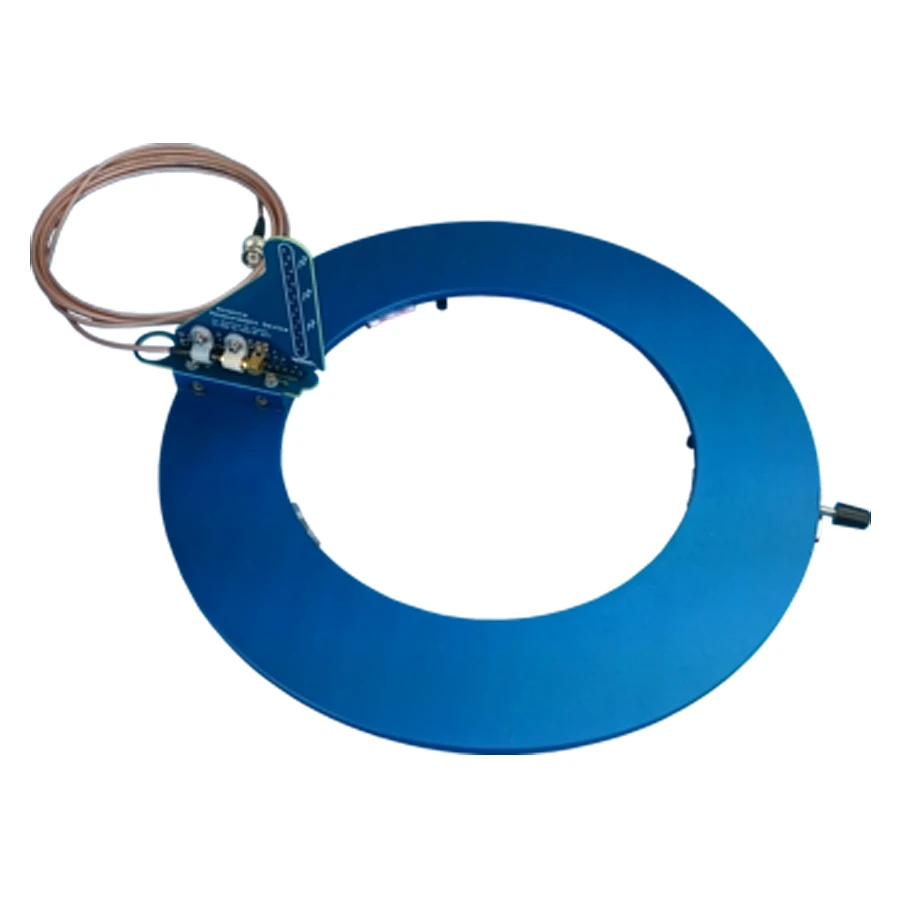
RAMP Tester
The RT-600 ramp tester is a measuring device that enables a rapid functional test of the RT-600. It consists of the antenna measurement device and an optional RF signal generator, which allows the testing of arbitrary frequencies within the RT-600 frequency range. The ramp tester can be easily attached to the RT-600 AU and allows a functional test in 45 ° increments. It offers a comprehensive performance test of the DF system mounted on the aircraft, including DF accuracy, bearing sensitivity and audiomodulation test.
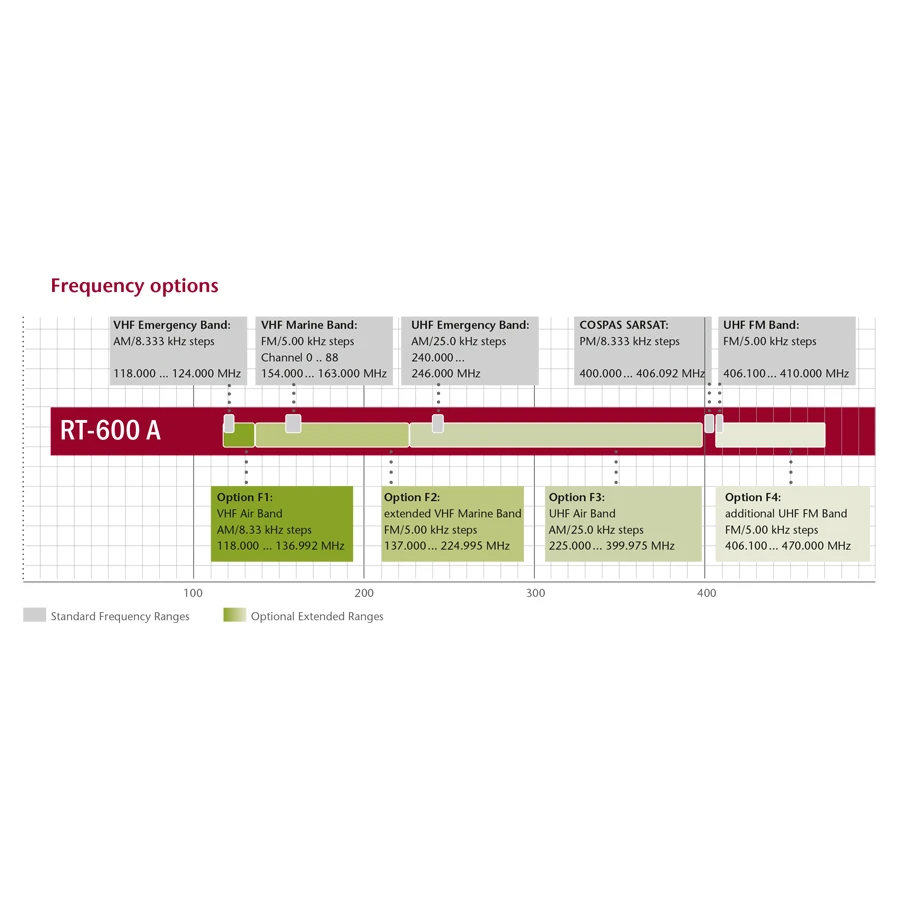
Frequency options RT-600 A
F1 VHF-Airband: 118.000 bis 136.992 MHz; F2 VHF-Marineband: 137.000 bis 224.995 MHz; F3 UHF-Airband: 225.000 bis 399.975 MHz; F4 UHF-FM Band: 406.100 bis 470.000 MHz
The Optional Frequency extensions can be ordered seperatly to extend the frequency range of each system individually.
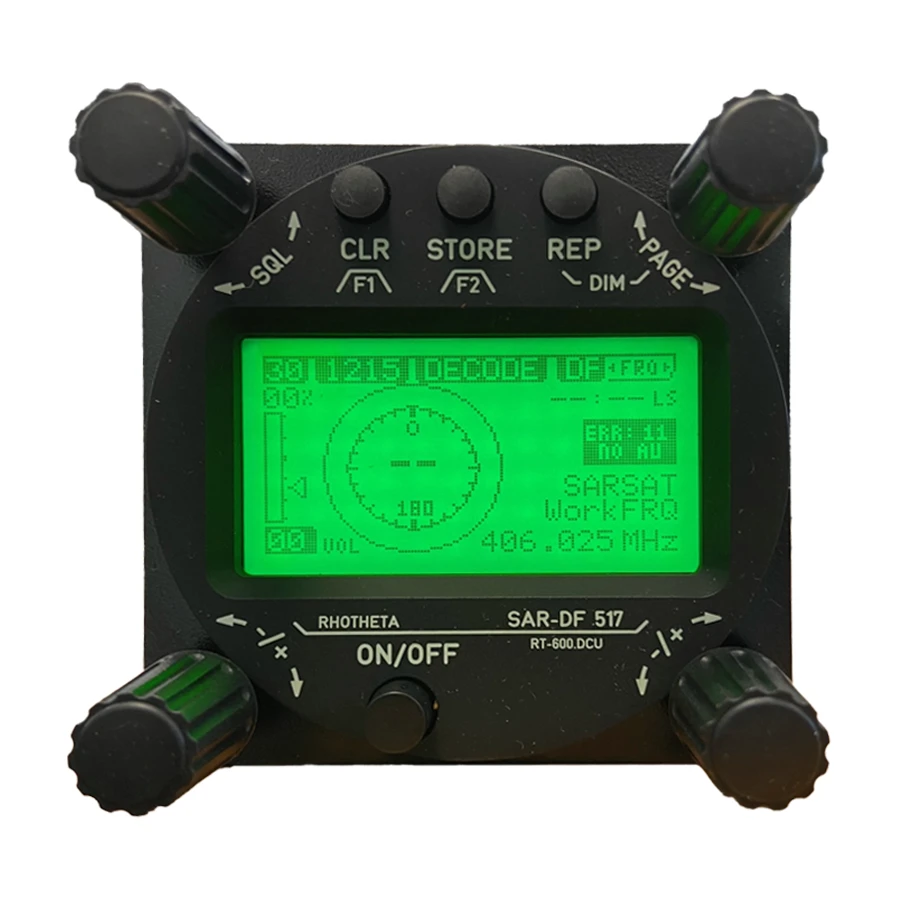
NVIS Display
The NVIS display variant of the RT-600 is designed for night use and meets the color spectrum requirements that are required for the use of night vision equipment.
RT-600
References

 RT-600